
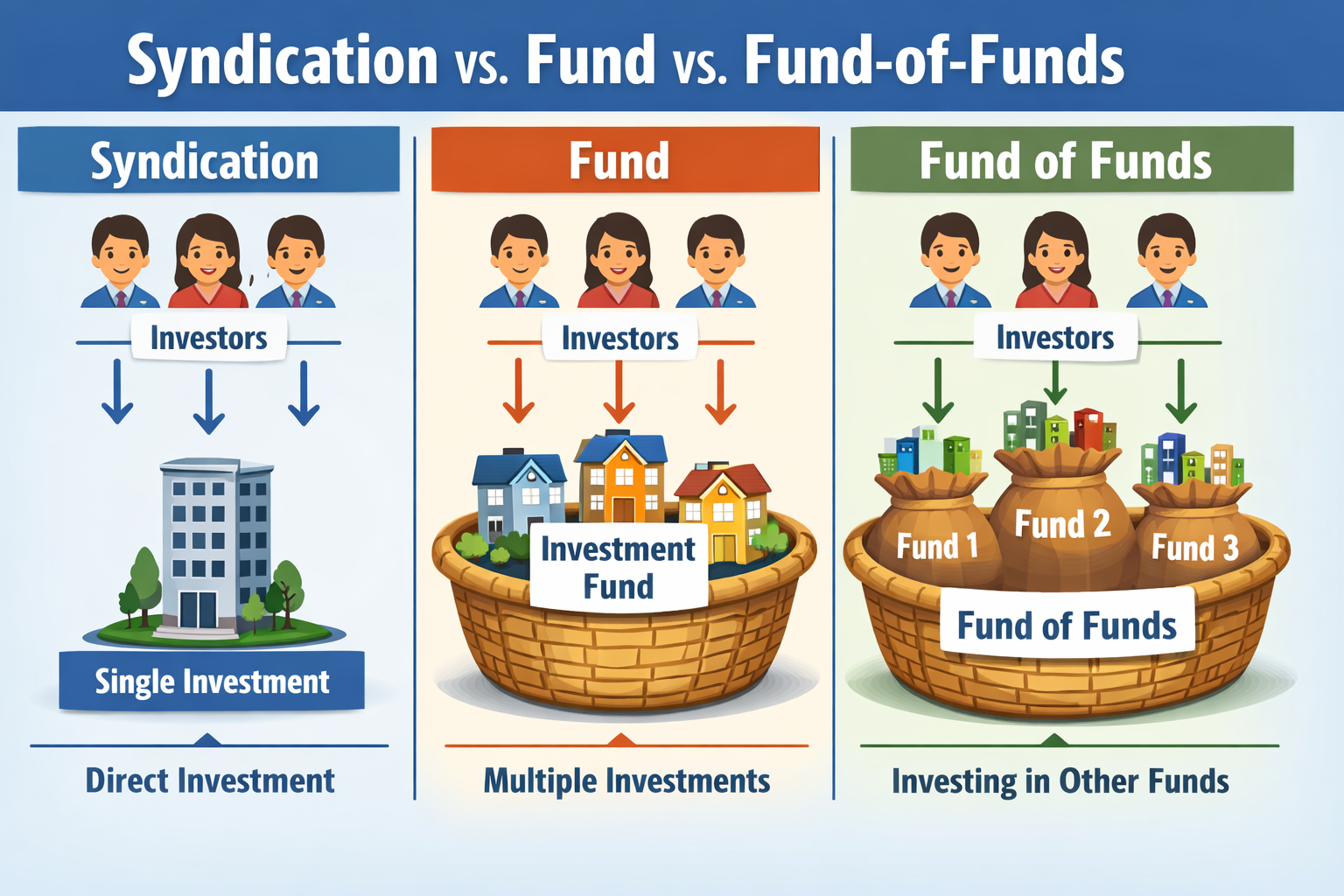

Syndications, Funds, and Fund-of-Funds — Understanding the Structures

Parker Webb
Passive real estate investing comes in several structural flavors, each with different risk profiles, fee structures, diversification characteristics, and investor rights. Understanding the differences before you invest isn't optional — it's foundational.
The syndication
A syndication is the simplest structure: a single asset, a single deal, a defined timeline. The sponsor finds a specific property, raises equity from a group of investors, acquires it, operates it, and eventually sells or refinances it.
These deals are typically structured as LLCs. Passive investors own a class of membership interests (typically "Class A"), which carry a preferred return and a defined share of profits. The sponsor holds a separate class of interests (typically "Class B"), which receive the "promote" — a disproportionate share of upside once the preferred return threshold is met. The sponsor is separately compensated for its work through acquisition, management, and disposition fees, and may manage the LLC directly or through an affiliated entity.
The advantages of syndications are real. You can underwrite the specific asset before writing a check — reviewing the rent roll, the lease terms, the market comparables, the debt structure, the business plan. There's no blind pool risk, meaning you aren't trusting a manager to deploy capital into deals you haven't seen. What you see is what you're buying.
Your return depends entirely on that one asset and that one operator's execution — concentration risk is the defining characteristic of the structure. If the market softens, a major tenant vacates, or the business plan hits unexpected friction, there's no other asset in the pool to offset the impact.
And as with any private real estate investment, capital calls are possible. If the asset requires additional equity — a major capital expense, a debt maturity that needs to be bridged, a lease-up that takes longer than projected — investors may be asked to contribute beyond their original commitment. That's not a sign of a bad deal, but it's a reality that every syndication investor should be financially and psychologically prepared for before they commit.
Syndications tend to appeal to investors who want visibility into exactly what they own, are comfortable concentrating capital in a single well-underwritten asset, and have the ability and willingness to evaluate deals on their own merits — or to rely on an operator whose judgment they trust deeply.
The fund
A fund raises capital before deploying it, typically with a defined strategy but without specific assets identified at the time of raise. This is the "blind pool" dynamic — you're committing capital to a strategy and a sponsor before you know exactly what you're buying. For investors accustomed to underwriting specific assets, that requires a different kind of confidence.
The structure works like this: the sponsor defines an investment mandate — say, value-add neighborhood retail in secondary Midwest markets — raises a pool of capital from investors, and deploys it into multiple assets over a defined investment period, typically two to five years. Like syndications, funds are generally structured as LLCs or limited partnerships with similar class structures, preferred returns, and sponsor promotes. The sponsor earns fees for managing the fund and executing acquisitions, and may deploy capital through individual deal-level entities underneath the fund.
Not all funds are fully blind. Some sponsors launch with one or more assets already identified and disclosed, giving investors visibility into the initial portfolio before committing. The remaining capital is then deployed into additional assets that fit the mandate as conditions allow. This semi-blind structure reduces blind pool risk without sacrificing the flexibility that makes a fund useful in the first place, and is increasingly common among sponsors who want to give investors a concrete starting point rather than asking for a fully unconditional leap of faith.
The advantages of funds are meaningful. Diversification across multiple assets reduces the impact of any single underperformer — if one tenant vacates or one market softens, the rest of the portfolio absorbs it. Capital is also deployed over time rather than all at once, which reduces vintage risk: you're not betting everything on conditions at a single point in the market cycle. And because the sponsor has discretion to act as opportunities arise, a well-managed fund can be genuinely opportunistic in ways a pre-identified syndication cannot.
The tradeoffs are real. Blind pool risk is the central one — you are underwriting the sponsor's judgment, track record, and strategy rather than a specific asset. That requires a higher level of confidence in the operator than a syndication does, because you won't see each deal before capital is committed. Funds also tend to have longer investment horizons and less interim liquidity than syndications, and the diversification that protects against concentration risk also means your upside on any single home-run asset is diluted across the portfolio.
Funds tend to appeal to investors who have high conviction in a sponsor and strategy, want diversification without managing a portfolio of individual syndication investments, and are comfortable trading asset-level transparency for broader exposure and reduced concentration risk.
The fund-of-funds
A fund-of-funds raises capital and invests it into other funds rather than directly into real estate. An investor in a fund-of-funds gets exposure to multiple operators, strategies, and markets through a single vehicle — a one-check solution for broad private market diversification.
The advantages are real: reduced single-manager risk, built-in diversification across strategies and geographies, and simplified administration for the investor — typically one K-1 instead of many.
The tradeoffs are also real. Fee layering is the central one. The fund-of-funds manager charges its own fees and carried interest on top of whatever the underlying funds charge — meaning returns pass through two promote structures before reaching the investor. Net returns can be meaningfully diluted as a result. The investor also cedes the ability to select specific operators or strategies, trading control for convenience.
Fund-of-funds tend to appeal to investors who want broad private market exposure through a single relationship and are willing to pay for the simplicity.
Which structure is right for you
There's no universal answer, but there are honest guidelines.
If you're deploying a relatively small amount into real estate — say, $100,000 to $250,000 — a well-structured fund offers diversification that a single syndication can't provide at that capital level. You're buying exposure to a strategy and an operator rather than betting everything on one asset.
If you're deploying more significant capital and have the time and expertise to evaluate individual deals, direct syndications offer transparency and the ability to concentrate in high-conviction opportunities. You see exactly what you're buying before you commit.
If you want broad exposure with minimal due diligence, a fund-of-funds might make sense — but scrutinize the fee structure carefully. The convenience is real. So is the cost.
Most serious allocators end up with a mix: a fund or two as their core real estate exposure, supplemented by direct syndications where they have particular conviction in the operator, the deal, or the market.
The structure should follow the strategy, not the other way around.