
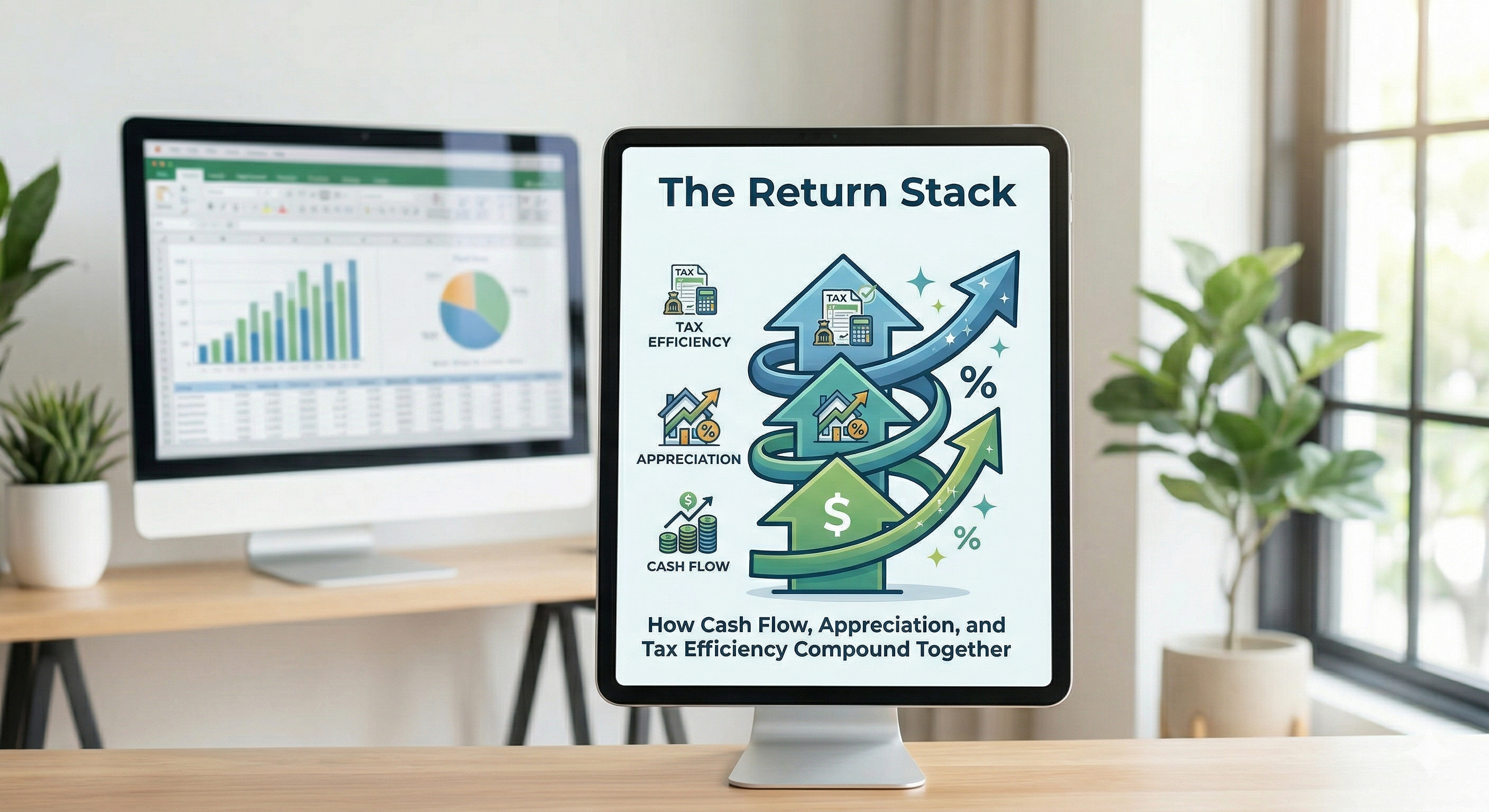

The Return Stack — How Cash Flow, Appreciation, and Tax Efficiency Compound Together

Parker Webb
Public market investments are generally straightforward in how they generate returns: price appreciation, dividends, and interest. That simplicity is a feature — index funds are easy to understand, easy to compare, and for most investors building long-term wealth, they do exactly what they're supposed to do. The data on trying to consistently outperform public markets through active selection is also clear: most attempts fail over long time horizons, which is why low-cost index investing has become the default recommendation for good reason.
Private real estate returns work differently — not better by definition, but differently in structure. The same investment can be generating current income through distributions, building equity through appreciation, and creating tax benefits through depreciation — simultaneously. Understanding how these three components interact is essential to evaluating whether the projected returns in a deal are realistic, and whether the overall structure makes sense for your portfolio relative to what you're already holding.
Cash flow
The first dimension is current cash flow — the distributions received during the hold period from net operating income after debt service and any partnership level expenses. In a well-underwritten stabilized asset, this produces a cash-on-cash return: how much cash you receive annually relative to your invested equity.
A deal projecting 6-8% cash-on-cash returns is generating meaningful current income, independent of what the asset is eventually worth at exit. For investors who want their capital working during the hold period — not just at the end — cash flow is the component to focus on.
Appreciation
The second dimension is equity appreciation — the increase in the asset's value over the hold period. In commercial real estate, value is derived from income, not sentiment. The math is straightforward: value equals net operating income divided by the capitalization rate. That means appreciation happens in one of two ways.
The first is income-driven appreciation: NOI increases through higher rents, improved occupancy, or reduced expenses, and that higher income stream is worth more at the same or a compressing cap rate. The second is forced appreciation: the operator actively improves the asset through better management, capital improvements, or repositioning — driving NOI higher than it would have been otherwise. A retail center acquired at a 6.5% cap rate with 82% occupancy, stabilized to 95%, and sold at the same cap rate produces a significant return purely from that income improvement, without requiring the market to move at all. These two forms of appreciation often work together.
Cap rate movement matters too, and cuts both ways. A compressing cap rate — where buyers are willing to accept lower yields — amplifies appreciation even on flat NOI. An expanding cap rate environment, like the one that followed rapid interest rate increases in 2022 and 2023, can erode value even when an asset is performing well operationally. Realistic underwriting assumes some sensitivity to cap rate movement at exit, not just a straight-line NOI growth story.
Tax efficiency
The third dimension is often the most underappreciated by new real estate investors: the tax treatment. Real estate investors can deduct depreciation on the physical asset — typically over 27.5 years for residential and 39 years for commercial — which creates a paper loss that reduces taxable income even when the asset is generating positive cash flow. Mortgage interest is also deductible, adding another layer of shelter against ordinary income.
The result is that an investor can receive meaningful cash distributions in a given year while simultaneously showing a loss on their K-1. That paper loss can offset other passive income, reducing the investor's overall tax burden in ways that dividends, interest, and capital gains from public markets generally cannot.
Cost segregation studies can amplify this further. By accelerating depreciation on certain components of a property into shorter recovery periods, cost segregation can front-load significant paper losses into the early years of ownership — sometimes enough to offset a substantial portion of the initial investment in Year 1 alone.
At sale, two additional tools matter. A 1031 exchange allows an investor to defer capital gains taxes by rolling proceeds into a like-kind replacement property — preserving equity that would otherwise go to the IRS. A 721 exchange allows an investor to contribute property into an operating partnership — not limited to REITs, though that's the most commonly referenced application — in exchange for partnership units, deferring gain while maintaining real estate exposure., deferring gain while maintaining real estate exposure in a more liquid structure.
None of this makes real estate tax-free. Depreciation is recaptured at sale, and the interplay between these tools is genuinely complex. The tax dimension is one of the most compelling aspects of real estate investing — and one of the areas where working with a qualified CPA and attorney who specialize in real estate is not optional. The strategies are real. The details matter enormously.
How the three dimensions interact
The full picture of a real estate investment's return comes from layering all three. A deal with modest cash flow but strong forced appreciation might still produce an excellent IRR. A deal with strong cash flow, market appreciation, and meaningful tax benefits might be worth accepting a lower headline IRR for, because the after-tax, after-fee return is exceptional.
This is why IRR alone — while useful — isn't the complete picture for real estate investments. Equity multiple, cash-on-cash yield, and effective tax rate are all relevant inputs to a complete evaluation.
The best deals deliver across all three dimensions — and the operators worth backing understand how to underwrite, structure, and manage for all three simultaneously. That's a narrower field than it appears. But for investors who know how to evaluate it, that's exactly where the edge is.