
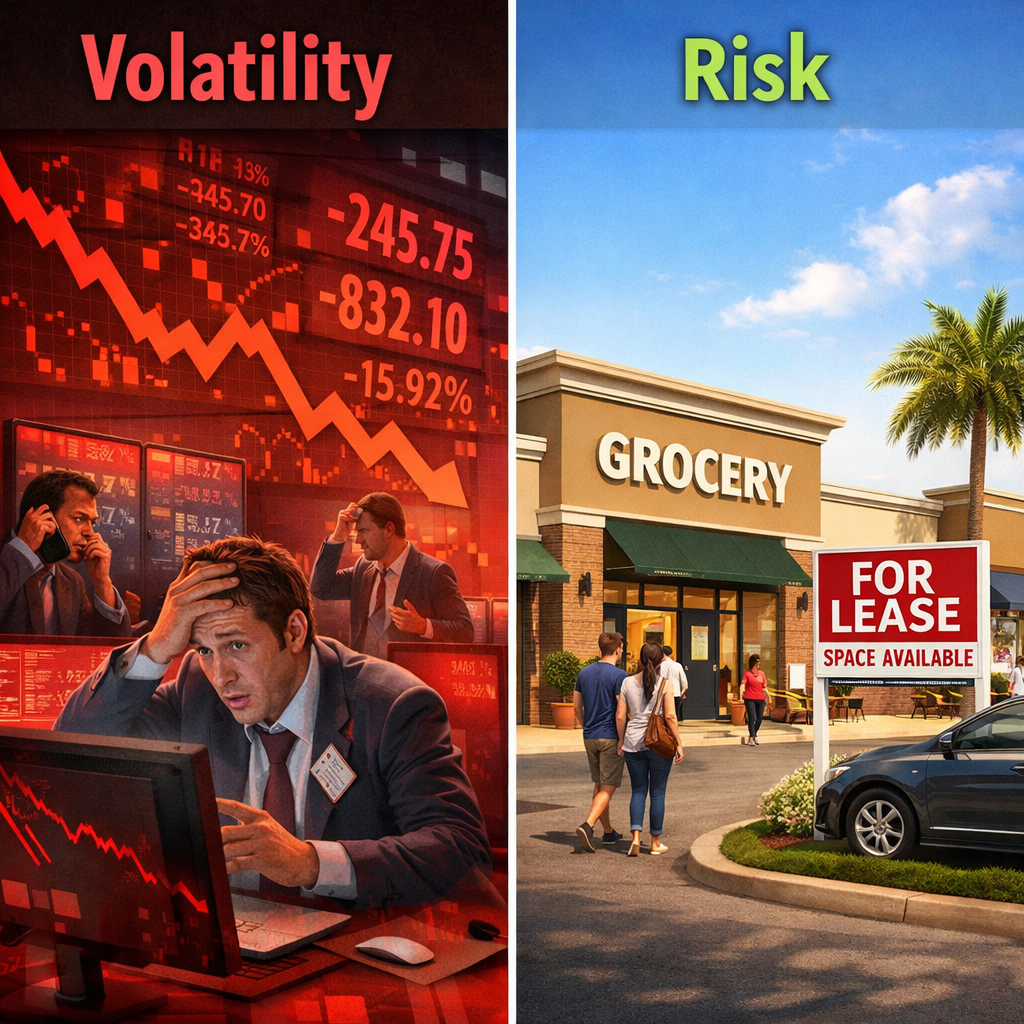

Volatility vs. Risk — The Distinction That Changes Everything

Parker Webb
Ask most investors what they're afraid of, and they'll describe volatility. Watching a portfolio drop 25% in a bear market. Seeing red every day on the screen. The gut-punch of a bad quarter.
What they're actually describing is discomfort. Not risk.
Real risk — the kind that should actually keep you up at night — is the permanent impairment of capital. The investment that goes to zero. The inflation that quietly cuts your purchasing power in half over 20 years. The sequence of returns that wrecks your retirement if it hits at the wrong time.
These are different problems, and conflating them leads to genuinely bad decisions.
Why the financial industry loves volatility as a proxy for risk
Standard portfolio theory — the kind taught in every business school and deployed by every major wealth management firm — uses standard deviation as its primary measure of risk. Standard deviation measures how much an asset's returns fluctuate over time. High fluctuation equals high "risk." Low fluctuation equals low "risk."
This is convenient for several reasons. Publicly traded assets have daily prices, which makes standard deviation easy to calculate. It produces clean charts. It justifies the "diversified" portfolio of stocks and bonds that most retail and mass-affluent investors hold.
It also systematically understates the risk of low-volatility assets (like long-duration bonds or cash, which lose purchasing power reliably but quietly) and overstates the risk of illiquid private assets, which show no price volatility at all — not because they're inherently stable, but because they don't have a daily price to fluctuate.
What private real estate actually looks like
A well-underwritten commercial real estate investment doesn't have a ticker symbol. Its "value" on a given Tuesday isn't posted anywhere. What it has is cash flow — rents paid by tenants operating real businesses — and an underlying asset with replacement cost and intrinsic value.
When the stock market dropped 34% in March 2020, a grocery-anchored shopping center didn't lose a third of its value. The grocery store was still open. The rents were still (mostly) being paid. The physical asset didn't change. The mark-to-market volatility was effectively zero, because there was no continuous market doing the marking.
Does that mean private real estate is risk-free? Absolutely not. Tenants vacate. Markets soften. Operators make mistakes. Capital can be impaired. These are real risks that deserve serious underwriting.
And even good operators face conditions that no proforma anticipated. Capital can be impaired. These are real risks: some evaluable before you invest through market analysis, lease structure, debt coverage, and operator track record, and some that only reveal themselves years later as real-world conditions diverge from original assumptions.
But these risks are fundamentally different from public market sentiment risk in how they manifest. Public equities reprice in real time — sentiment shifts overnight and your portfolio reflects it immediately.
Real estate absorbs sentiment slowly: capital flows in, cap rates compress, assets trade above where fundamentals justify — and then the correction comes, just on a multi-year timeline rather than a multi-week one.
That lag cuts both ways. It means you can get stuck in an overpriced asset longer than you'd like, but it also means dislocations create real buy and sell opportunities for operators paying attention. The risk isn't absent — it's just slower, stickier, and more navigable for someone who knows what they're looking at.
The practical implication
If you've been keeping money in "safe" liquid assets because you can't stomach volatility, it's worth asking what you're actually protecting against. If the honest answer is discomfort rather than genuine capital need, you may be paying a significant opportunity cost for the feeling of safety.
Discomfort is manageable. Permanent capital impairment is not. Knowing the difference is the foundation of a serious investment approach.